The man who cleans up
blood after murders
·
19 September 2016
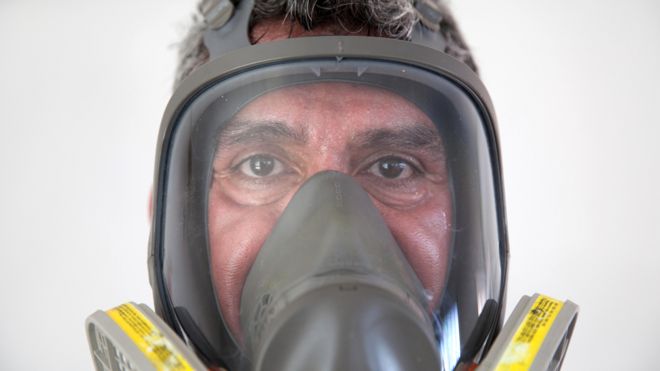
Mexico has one of the highest murder rates in the world, but who
cleans up the blood at the crime scene when the police and investigators have
left? Donovan Tavera is Mexico's first forensic cleaner. As he explains here,
his fascination with blood began as a young boy.
What happens to the blood after a murder? The question haunted
me for years, until I answered it myself.
The first time I saw a dead body was when I was 12 years old.
Early one morning we heard that somebody had died on the street outside our
block of flats. We went out to look. There were clear signs of violence. The
man didn't have a shirt. I was struck by the streams of blood going down the
street. But I didn't feel scared - I was just very curious. And that's how my
fascination with blood began.
As well as us bystanders there were police officers and
investigators. I kept waiting for someone to come and clean up the blood, but
no-one came. Some of the blood even ran towards our building and my mother
washed it away with water.
I asked her: "Who cleans the blood after a murder?" I
asked her so many questions that day.
When my father came home from work I asked him too: "What
happens to the blood after a murder? How do you clean it up?" I kept
asking about it for days, until he said, "Please stop talking about this.
Enough!"
That was when I decided to find out for myself. I went to the library
and took out a book on medicine, but that was too general. Then I found a book
about forensic medicine. I read about the process of death and what happens to
a corpse. I learned a lot.
A murder isn't the same as an accident - in a murder there is a
lot of blood. And blood can carry diseases. It seemed to me that if someone
takes bodies from the street, there should also be a professional who cleans up
the blood.
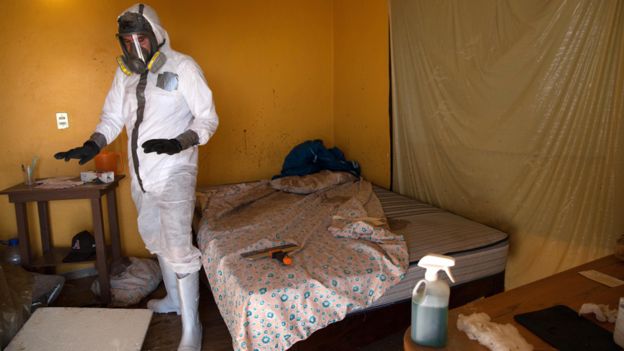
When I was about 17 I started experimenting. I went to the
butcher and bought cow's liver and bones and then at home I would investigate
how to clean up the blood.
And that's how I became a forensic cleaner.
Over the years I have invented more than 300 different formulas
to clean up blood. Some I have perfected over the years. Others haven't changed
since I first used them.
You need different methods depending on what you are cleaning -
whether it's the carpet of a car, for instance, or personal objects like
watches or rings. It also depends on how and when the person died. For
instance, someone may have been lying dead in the bathroom of their house for a
week, in a humid environment. In another situation, perhaps where a man has
hung himself with his own tie, you need to consider other bodily fluids such as
semen or faeces.
Before I come I ask what happened, and where the corpse is. I
also need to know if the dead person was ill, and if there is a chance of
contamination. That way I can plan ahead
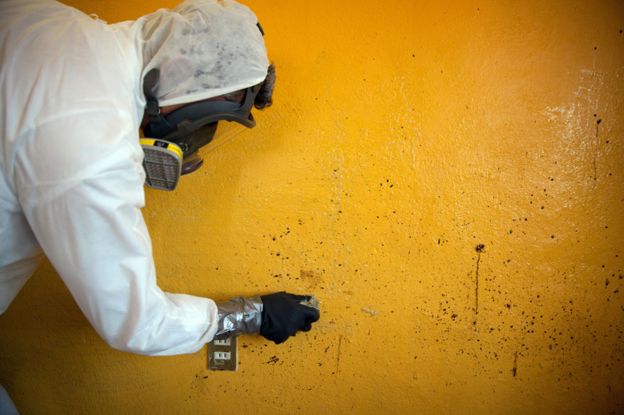
I am the last person to visit the scene of the crime. I come
after the police officers have left, and after the funeral has taken place. I
am the last person associated with what happened, and often the dead person's
family use me as a bit of a therapist. In the beginning I used to get
personally affected, but now I listen politely and then get on with my work.
I usually work with my headphones on because music helps me
concentrate. I always listen to the same three things: Tristan und Isolde by
Wagner, 666 Number of the Beast by Iron Maiden and Paranoid by Black Sabbath.
The opera relaxes me, it helps me concentrate and prepare mentally. But once I
put my uniform on and start cleaning, I want to listen to heavy metal.
My work can only begin once the authorities have issued a legal
statement saying someone outside the police investigation is allowed on the
scene of the crime. Without that piece of paper, I can't do my job.
A few times people have called me to do a job, but when I asked
them for those legal documents, they didn't have them. Instead, they offered me
money - good money. When I told them I couldn't work without the proper
authorisation, they quickly hung up. They may have been criminals, or perhaps
it was a joke, I don't know.
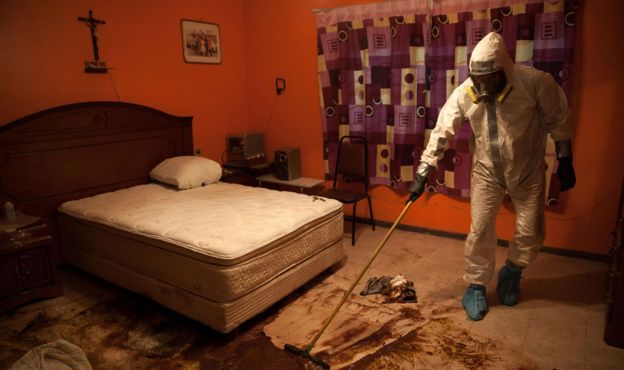
The people who hire me are going through a very painful
situation. From the moment the dead body is found until I have finished, they
have to live with the blood - on the floor, on the walls, in the bathroom. And
it smells. So when the house is clean and the smell has gone, their mood
changes. Often, they cry with relief - a burden has been lifted. They no longer
have to live with that shocking scene. It still hurts, but it's one less burden
to carry.
The worst crime I've had to clean up was a multiple homicide in
Mexico City where four people died. They were stabbed and the traces I saw
showed signs of self-defence and panic. There was a lot of anger and
desperation at that scene. It took us more than 10 hours to clean it - we had
to hand over the house on the same day. My client was devastated, but in the
end we gave back a place without a single trace of what had happened. My work
had helped in some way and afterwards the person thanked me in a very nice way.
There was a totally different atmosphere - it felt light, as if what had
happened had happened a long time ago, like a distant memory.
I never thought this would be how I earn my living. I didn't
even know this profession existed until I taught myself how to do it.
Opinion: It is intriguing that there is a job for cleaning
blood. I didn’t hear anything about that. For all these years I haven’t been
thinking outside the box and I have been looking only at the events that
happen. If there wasn’t anyone that cleans up blood after a crime, the world
would be in a mess. I only thought that the people around that area clean the
mess but I was wrong. This news fascinated me because people around the area ignore
about the mess just like the author’s parents. I also learned that it is dangerous
to leave blood in the open for they can carry diseases. I think that the author
is advertising the job of blood cleaning for it hasn’t been known to the world
as much. Also, he is trying to inform all the people about what is not known
commonly, the dangers of leaving blood in the open. The author doesn’t seem to
have any negative emotions upon the murderer or murderers. For normal people,
they would think more about catching the murderers, but this author seems to be
slightly supporting them. If there is not crime, his job would be pointless.
